
A market that has grown faster than almost any sport
The Lawn Tennis Association, which governs padel in Britain, reported in May 2026 that one million adults and juniors now play padel, on 1,825 courts at 551 venues (LTA Padel). The same figures put players at 15,000 in 2019 and around 400,000 at the end of 2024. Courts are growing too, but demand has run ahead of supply in many areas, which is why well-placed courts book up.
Growth on that scale attracts a lot of new courts, and not all of them will be busy. The opportunity is real, but it is local: who lives within a short drive, what they can already play nearby, and what they will pay. That is the first thing to test.
Why golf clubs are well placed
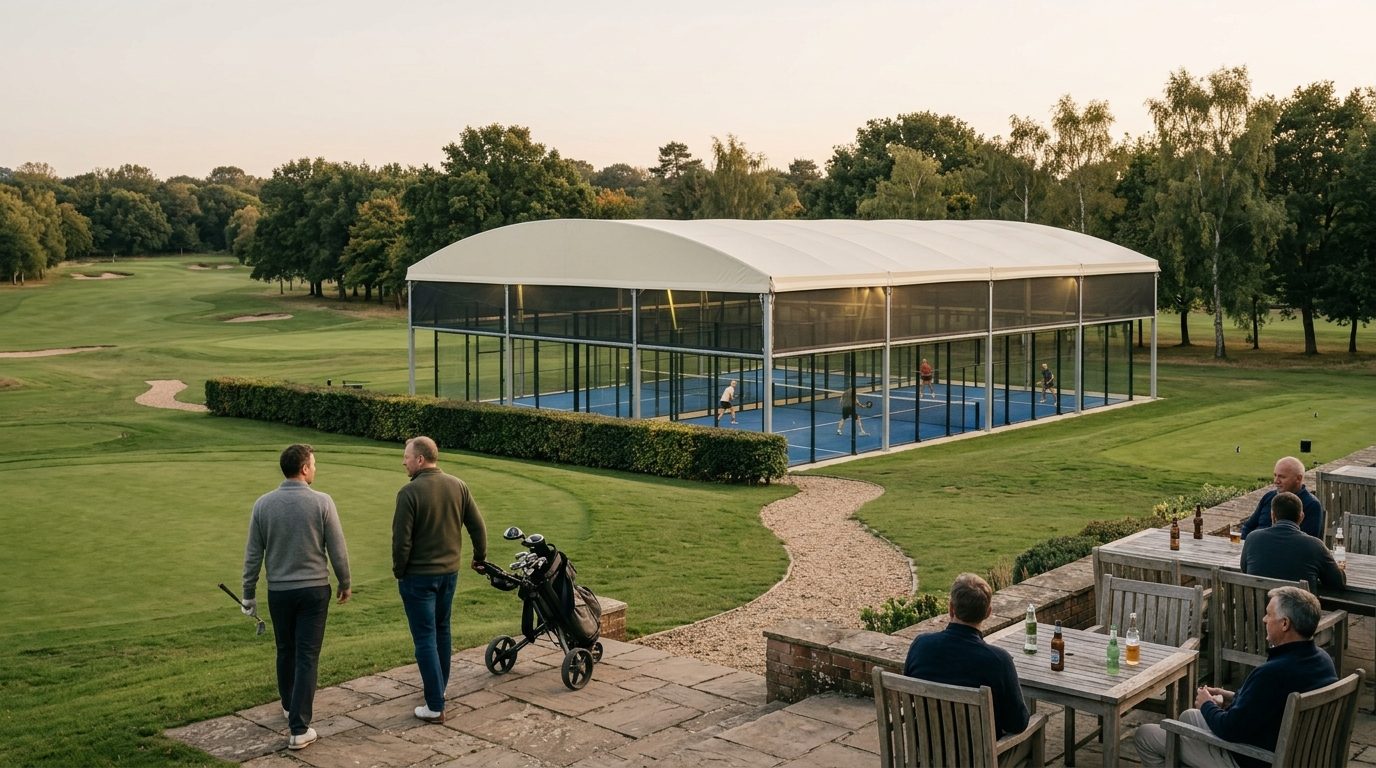
A padel court is 20 by 10 metres. Four courts with circulation fit comfortably on a practice area, an unused corner of car park, or the land around a tired tennis court. Most golf clubs also have what a standalone padel venue has to build or rent: parking, changing rooms, a bar and kitchen, staff, a booking system and an established name locally.
Clubs already offering padel range from Royal Norwich, South Buckinghamshire and Trevose to The R&A's community golf centre at Lethamhill in Glasgow, which included covered padel in its plans (Golf Business News). Operators have also noted that golf clubs avoid some of the friction padel meets at tennis clubs, where courts can compete with existing tennis provision (The Padel Paper).
The complementary income streams
The strength of padel at a golf club is that it fills the hours golf does not. Golf is busiest on mornings and weekends in the light half of the year; padel's peak is weekday evenings under lights, all year round under a canopy. The same clubhouse, staff and bar earn twice.
- Court hire: pay-and-play bookings from members and the public, priced by peak and off-peak.
- Padel membership: a padel-only tier, or padel added to a golf membership for a supplement.
- Coaching, clinics and junior programmes, often run by a resident coach on a revenue share.
- Leagues, socials and tournaments that bring players back weekly.
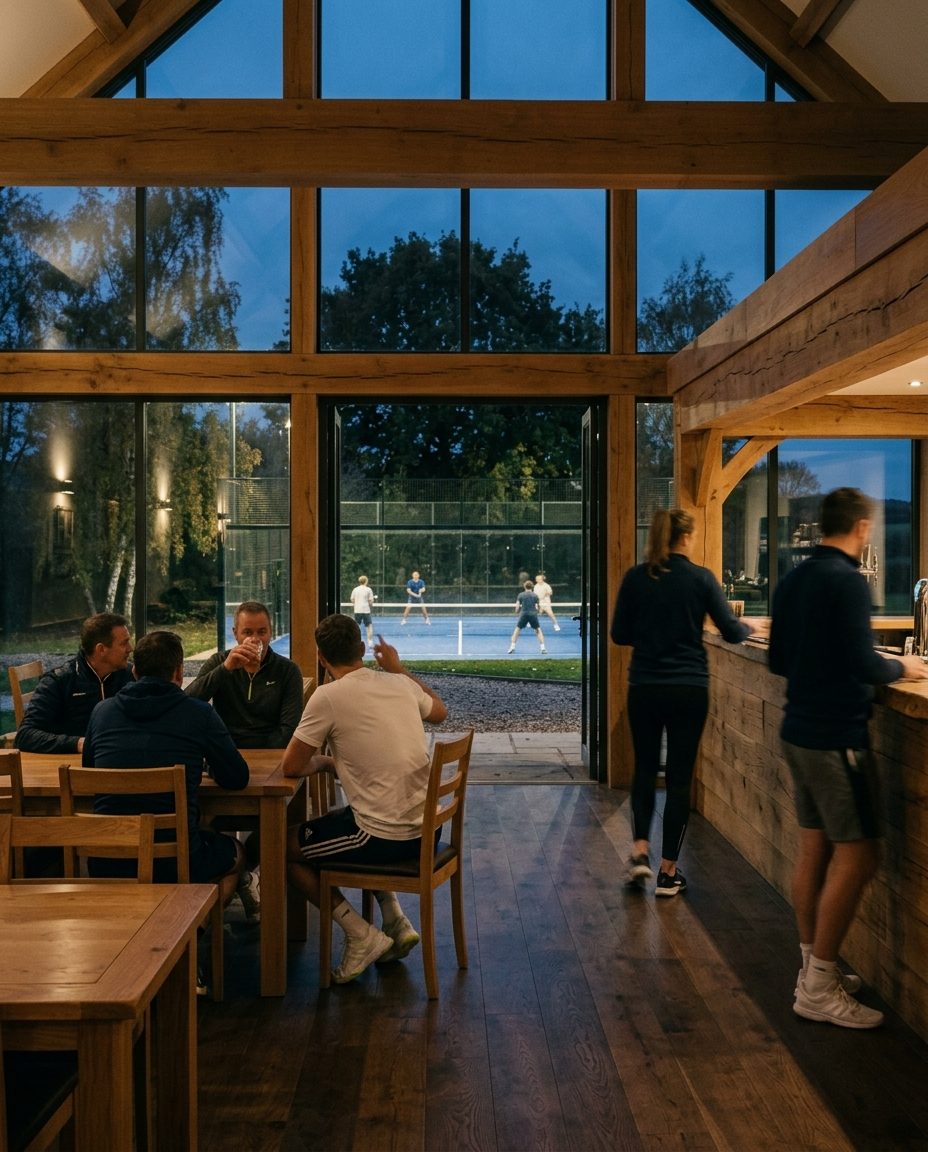
- Food and drink: padel is a social game played in fours, and players stay afterwards.
- Corporate and private events: golf in the morning, padel in the afternoon, dinner in the clubhouse.
Leveraging the membership, and growing it
Golf club membership in England is healthy: England Golf reported 750,071 members in 2025, up 2.66% on the year, with junior membership up by more than a third (England Golf via Northern Golfer). But the average club member is around 55, while golfers who play without joining a club average 43 (GCMA, from England Golf data). Padel reaches exactly the younger players and families that clubs want to bring through the door.
Handled well, padel works in both directions. Existing members get another reason to use the club, and their families a reason to come with them, which supports retention. New padel players discover the club, the bar and eventually the course, which gives the club a pipeline of future golf members. One golf club's planning application made exactly this case: broader appeal, more food and drink trade and better retention (Derbyshire Times).
The membership offer needs designing, not just adding: what golf members get (priority booking, member rates), what padel-only members get, how public bookings are released, and how padel players are introduced to golf.
How to operate it: three models
There is no single right way to run padel at a golf club. The choice is a trade between how much capital the club puts in, how much income it keeps, and how much of the work it takes on.
| Club builds and runs | Operator partnership | Club owns, operator manages | |
|---|---|---|---|
| Who pays to build | The club | The operator | Club, often with finance |
| Who runs it day to day | The club | The operator | Operator, under the club's brand |
| Club's income | All court, coaching and membership income | Rent or a share of revenue | A management fee is deducted; the rest is the club's |
| Club's risk | Highest | Lowest | Shared |
| Control of pricing and member access | Full | Agreed in the lease | Full, with operator advice |
| Suits | Clubs with capital and an appetite to run it | Clubs that want income without capital or workload | Clubs that want ownership but not the day-to-day |
Whichever model, the essentials are the same: online booking with dynamic pricing, a clear policy on member and public access, a coach, a programme of leagues and socials, and someone accountable for keeping the courts full through the winter.
What to get right before you build
- Demand: model bookings month by month, including winter and cancellations, before choosing how many courts to build.
- Position on site: close to the clubhouse and parking, clear of greens, tees and neighbours, and visible from the terrace.
- Cover: in the UK climate a canopy, ideally with side mesh, is usually what turns a seasonal facility into a year-round one.
- Planning: most padel courts need permission. Noise, floodlighting and the canopy's appearance are the issues to evidence early.
- Ground and drainage: a level, free-draining base and properly designed canopy foundations, resolved before the court supplier is appointed.
- Governance: in a members' club, a clear business case for the committee and the membership vote.
The bottom line
Padel will not replace golf, and it should not try to. Its value to a golf club is that it uses the club's existing assets at different hours, for a younger and broader audience, and turns some of them into members. The clubs that do well treat it as a business with its own plan, not as a set of courts.
If you would like an indicative budget for your scheme, leave your email and we will be in touch to talk through the number of courts, outdoor, covered or indoor, and how they would be installed.
We will only use your email to reply about your scheme and, if you wish, to send occasional padel insights.
We will test the demand, the site and the operating model, and give the committee a business case it can vote on.
Sources
- LTA Padel: 1,000,000 padel players in Britain (May 2026)
- LTA Padel: 860,000 players, latest figures on growth of padel (March 2026)
- England Golf membership figures 2025, reported by Northern Golfer
- GCMA: What England Golf data means for club management
- The Golf Business: golf clubs building padel courts
- Golf Business News: The R&A picks padel for community golf centre
- The Padel Paper: padel hooks up with golf
- Derbyshire Times: padel courts planned at Trent Lock Golf and Country Club